
Antelope Valley wildflowers
Hydroseeding in Lancaster, CA
Home of the California Poppy Festival, where shrubland covers most of the land and new homes come with solar.
- No-charge visits to your property, with estimates in writing
- Itemized quotes: prep, seed, mulch and erosion control
- Seed mixes picked for coast, basin, valley or foothill
Planting for the Mojave's Edge
Hydroseeding in Lancaster makes the most sense when it works with the desert rather than against it. The city lies in the western Mojave at about 2,359 feet, and shrublands cover about 80 percent of its area, with grasslands at about 7 percent. Lancaster City Park hosts the California Poppy Festival each spring, and lupines and poppies bloom across the valley in good years. That tells you what grows here without help.
Wildflower seeding
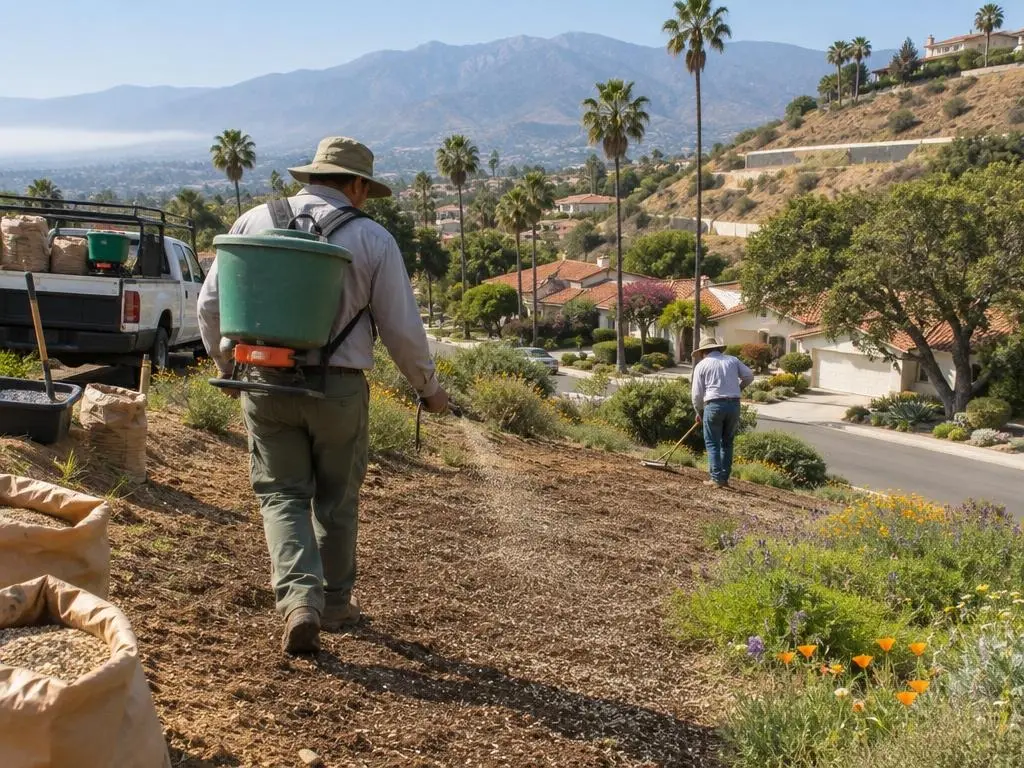
For large residential lots, open space at the edge of a subdivision or a commercial site that needs cover without a lawn, a poppy and lupine based wildflower mix sprayed with hydromulch is a strong option. We time it ahead of the wet months so the seed has the best chance. Expect it to look sparse the first season in a dry year and fill in over time.
Short, uneven rainy season
Normal precipitation is 6.81 inches a year, with February the wettest month at 1.76 inches and August nearly dry. Totals swing hard: the wettest rain year was 19.57 inches in 1992 to 1993, and the driest was 1.26 inches in 2012 to 2013. A seeding plan here needs a backup for dry winters, which usually means supplemental water for the first few months.
Cold nights, hot days
Lancaster sees about 68 mornings a year at or below freezing, and the mean daily maximum is near 98 F in July and August. Lawns need grass that handles both. We will tell you plainly if a lawn is a stretch for your yard and suggest alternatives.
New homes, new yards
In 2013 Lancaster became the first U.S. city to require solar panels on all new homes, effective January 2014, and housing units grew from 51,835 to 55,137 over the decade to 2020. Each new home leaves graded ground around it. We handle yard grading, topsoil and lawn seeding for owners, and silt fence and hydromulch for builders who need to hold soil until landscaping goes in.
Heavy rain still happens
The most precipitation recorded in 24 hours was 2.93 inches on March 1, 1983. A storm like that on a fresh pad will cut rills fast, so we keep erosion control in the plan even on flat desert lots. Get a free estimate or call (213) 451-4997.
Lancaster Land and Weather
- Land cover. Shrublands cover about 80 percent of the area, forests 8 percent and grasslands 7 percent.
- Precipitation. Normal annual precipitation is 6.81 inches, with February the wettest month at 1.76 inches.
- Frost. About 68 mornings a year reach a minimum at or below freezing.
- Solar mandate. Lancaster was the first U.S. city to require solar panels on all new homes, effective January 2014.
- Parkland. The city has over 600 acres of developed or planned parkland, including the Prime Desert Woodland Preserve.
Lancaster Questions
Can you hydroseed California poppies?
Yes. Poppies and lupines are common in Antelope Valley wildflower mixes and do well sprayed with hydromulch ahead of the rainy months.
How long until a wildflower seeding looks good?
It depends on rain. In a wet winter you may see color the first spring; in a dry one, expect a sparse start that improves over a few seasons.
Is hydroseed a good fit for a new-home backyard in Lancaster?
It can be, once the pad is loosened and amended and irrigation is in place. We can also mix lawn areas with native seeding to cut water use.
Do flat desert lots really erode?
Yes, during intense storms. Bare, graded soil can rill and wash onto streets, so builders often need silt fence and a mulch cover.
Free Estimates in Lancaster, CA
Ask about lawn, wildflower or mixed seeding for your lot.
Hydroseeding Near Lancaster
- Hydroseeding in Los Angeles, CA
- Hydroseeding in Santa Clarita, CA
- Hydroseeding in Palmdale, CA
- Hydroseeding in Thousand Oaks, CA
- Hydroseeding in Simi Valley, CA
- Hydroseeding in Calabasas, CA
- Hydroseeding in Malibu, CA
- Hydroseeding in Pasadena, CA
- Hydroseeding in Glendale, CA
- Hydroseeding in Burbank, CA
- Hydroseeding in Rancho Palos Verdes, CA
- Hydroseeding in Agoura Hills, CA
- Hydroseeding in Diamond Bar, CA
- Hydroseeding in Glendora, CA
- Hydroseeding in Claremont, CA
- Hydroseeding in La Canada Flintridge, CA
- Hydroseeding in Altadena, CA
- Hydroseeding in Whittier, CA
- Hydroseeding in Moorpark, CA
- Hydroseeding in Chino Hills, CA
- Hydroseeding in Walnut, CA
- Hydroseeding in Sierra Madre, CA
- Hydroseeding in Westlake Village, CA